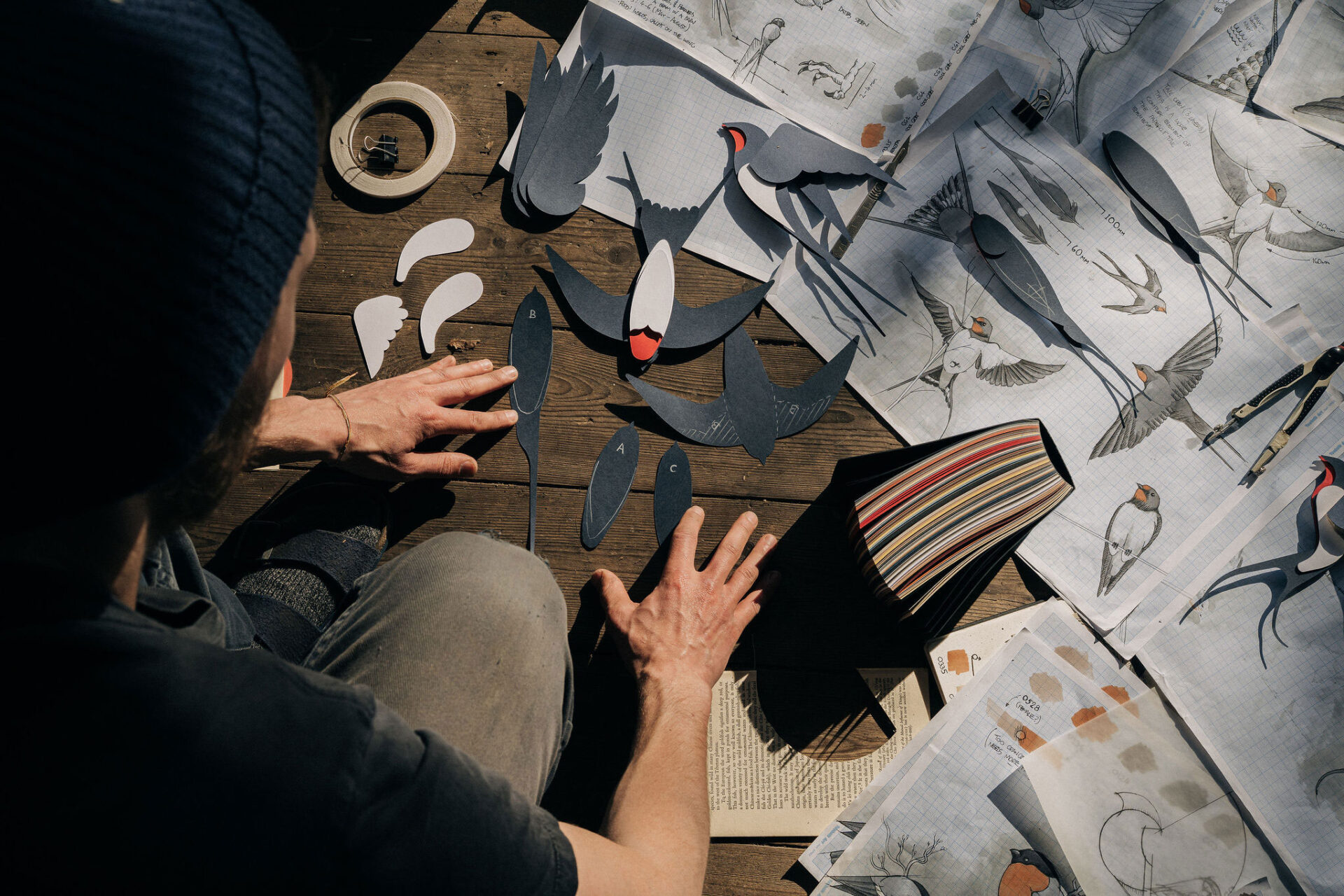
I’m sitting in the studio, surrounded by swallow sketches, scalpel blades, and paper prototypes, scattered across the floor.
The papercuts gently lift as the door opens—a delicate choreography of crated wings and wind.
Soon, these prototypes will become papercut activities for workshops, community hanging mobiles with children, storytelling props, and hanging pieces to be displayed in the National Museum of Scotland for the Scottish International Storytelling Festival coming up in October.

Funding from Creative Scotland has supported this new, exciting period of experimentation, beginning with a species close to my heart; Barn Swallows, Hirundo rustica.
Their shape and form call for careful attention — the arc of their wings, the fork of their tails, the way their bodies seem built for movement. Barn swallows don’t just fly; they write through the air, tracing long blue loops across sky and water.

To capture the flight of a barn swallow is an almost impossible task.
I find myself creating curves and lines that echo their motion, combined with the precise geometric shapes of a compass and ruler, as if structure might somehow meet the wild. Can a drawing ever truly hold the essence of a swallow’s wing—be it gliding in free flight, or fluttering at the nest?
Swallows have captivated the minds of artists and poets for centuries. For Ted Hughes, they are “the swallow of summer, cartwheeling through crimson… a boomerang of rejoicing shadow.”

While exploring the long lineage of poems that seek to honour their majesty, I came across The Blue Swallows by Howard Nemerov—one that turns the question back on language itself. It contrasts the beauty of the natural world with the artificial structures of the human mind:
“Seeing the swallows’ tails as nibs
Dipped in invisible ink, writing…
Poor mind, what would you have them write?”
Nemerov points toward a quieter truth: that true understanding comes from accepting that the natural world will always exceed what we can grasp. This idea feels important to me—challenging my use of both language and art, and bringing into question the temptation to turn every encounter with nature into a symbol, a meaning, a lesson.

But I like to think that words, pictures, and metaphors have deepened my relationship with the living world, rather than pulled me away from it.
Through them, I am finding a way to honour what can never be fully captured. Perhaps this is why I find myself searching for meaning in the movements of Barn Swallows—why, in grief, I’ve looked to them for direction.
For centuries, others have done the same: turning to birds in myth and folklore to make sense of death, to endure hardship, and to recognise small signs of hope offered by the more-than-human world.
For centuries, people have turned to birds in myth and folklore to endure times of hardship.

Pen down. Scalpel up.
Now begins the next phase: carving shapes, building layers, lifting paper into three dimensions from the initial sketches.
I began making swallow shapes in one continuous stroke — blade to paper. A single gesture.
If I rush, the form collapses. The swallow teaches me to work with steadiness and lift. The wings that don’t quite work tell their own stories. A heavy line, and the bird loses its sense of air. Too sharp a cut, and it becomes something else entirely. The successful ones are almost effortless — the shape feels like it remembers the sky.
As paper becomes shape and shadow, something shifts.
I know I will never capture the true essence of a flock of Swallows — but through the craft of papercut, I can feel myself edging closer to their flight.

Co-created butterflies and upcycled cabinets
Installing papercut butterflies inside historic museum drawers for an exhibition that brings together craft, community, and scientific collections.
3

